Mazzucchelli Acetate vs Chinese Acetate vs Japanese Acetate: A Sourcing Comparison for Eyewear Brands
This guide compares the three major acetate origins — Italian (Mazzucchelli), Chinese, and Japanese — across every factor that matters for acetate decisions. By the end, you will know exactly which grade fits your brand, your market, and your margin targets. Let’s look past the hype and see what really sets these three part.
For a broader overview of acetate eyewear manufacturing, materials, and factory selection, see our complete acetate eyewear sourcing guide.
What Is Cellulose Acetate and Why Does the Origin Matter?
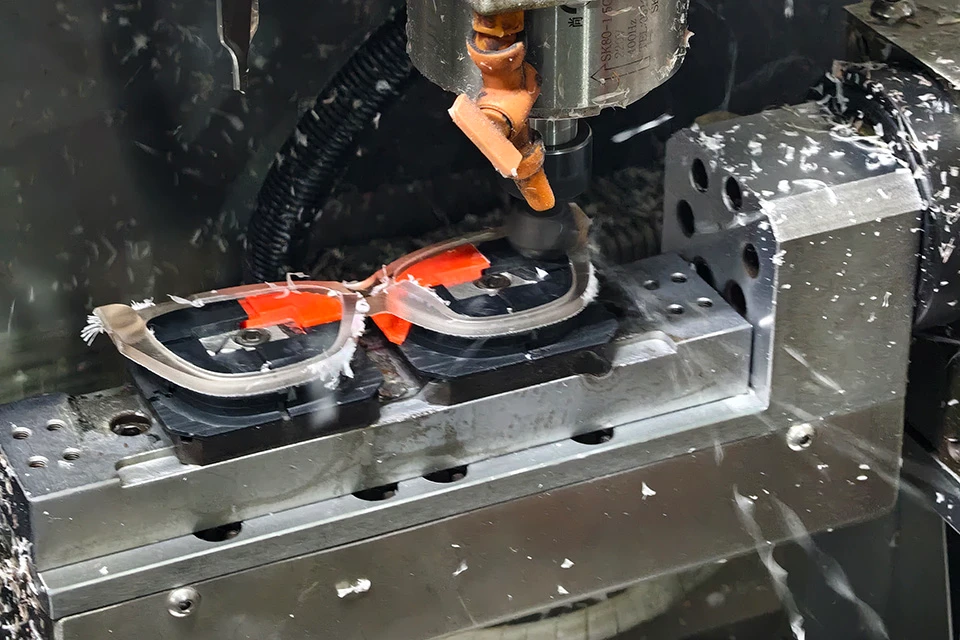
Cellulose acetate is a semi-synthetic polymer made from natural cellulose — typically derived from cotton linters or wood pulp — reacted with acetic acid. The resulting material is formed into sheets, blocks, or rods, which are then cut and machined into eyewear frames.
While the base chemistry is the same regardless of origin, the manufacturing process — how the sheets are pressed, cured, colored, and finished — varies significantly between producers. These process differences determine the acetate’s transparency, color stability, surface texture, dimensional consistency, and long-term durability.
Think of it like wine: the grape variety matters, but the terroir, the winemaker’s technique, and the aging process are what create the final character. The same principle applies to acetate. Two sheets with identical color formulations from different producers will look and perform differently on a finished frame.
Italian Acetate: Mazzucchelli 1849
Company Background
Mazzucchelli is eyewear’s oldest and most historic acetate producer, founded in 1849 in Castiglione Olona, Lombardy.
It began as a small family workshop making buttons and combs from horn and bone, and evolved generation after generation into a powerhouse that helped define the look of modern eyewear.
Still family-run after more than 170 years, Mazzucchelli transformed acetate into a creative medium. They pioneered marbling, transparencies, gradients, and tortoiseshells. They practically invented the colour language of eyewear.
Italian acetate is expressive and full of warmth. You can layer it, sculpt it, heat it, shape it. It’s forgiving, tactile and full of character, and no two sheets ever look exactly the same.

Quality Characteristics
Color depth and transparency. Mazzucchelli acetate is known for exceptional color saturation and optical clarity. Their proprietary layering and pressing techniques create patterns with remarkable depth — tortoiseshell patterns appear to have genuine three-dimensional character, and crystal colorways achieve a glass-like transparency that cheaper acetates cannot match.
Batch-to-batch consistency. This is perhaps Mazzucchelli’s greatest advantage for their customer. When you re-order a specific color six months later, the new batch will be virtually indistinguishable from the original. For brands that need color consistency across seasons and production runs, this reliability is critical.
Surface finish. Mazzucchelli sheets arrive with a surface quality that requires fewer polishing steps during frame production. This means less labor cost at the factory level and a more consistent final finish — though the raw material cost is higher.
Dimensional stability. The sheets hold their shape exceptionally well through the cutting, tumbling, and polishing stages of frame manufacturing. Frames made from Mazzucchelli acetate are less prone to warping or shrinking over time.
Bio-Acetate: Mazzucchelli M49
Mazzucchelli’s M49 line uses plant-derived plasticizers instead of petroleum-based ones, making it a bio-based acetate that is 100% biodegradable under industrial composting conditions. M49 carries ISCC (International Sustainability & Carbon Certification) and maintains the same quality characteristics as their standard acetate.
For brands targeting European markets where sustainability credentials influence purchasing decisions, M49 provides a genuine differentiator backed by third-party certification — not just a marketing claim.
Cost and Sourcing
- Raw material cost: Approximately 30-50% higher than Chinese acetate sheets
- Impact on frame unit cost: Roughly 15-25% higher per finished frame
- Minimum sheet order: Typically by weight (30-50kg minimum), with custom colors available at higher minimums
- Lead time for sheets: 6-8 weeks depending on color and availability
Best For
- Premium and luxury brand positioning
- European retail markets (especially where “Italian acetate” is a selling point)
- Brands with strong sustainability messaging (M49 bio-acetate)
- Collections requiring absolute color consistency across multiple seasons
- Optical chains and branded retailers with strict QC standards
Chinese Acetate: Jinyu, Jimei, and Other Domestic Producers
Industry Overview
China’s domestic acetate sheet industry has grown substantially over the past 15 years. The leading producers — including Jinyu (金雨) and Jimei (金美) — now supply the majority of mid-range eyewear production worldwide. China is both the largest producer and the largest consumer of acetate sheets for eyewear, which gives domestic manufacturers significant scale advantages.
Quality Characteristics
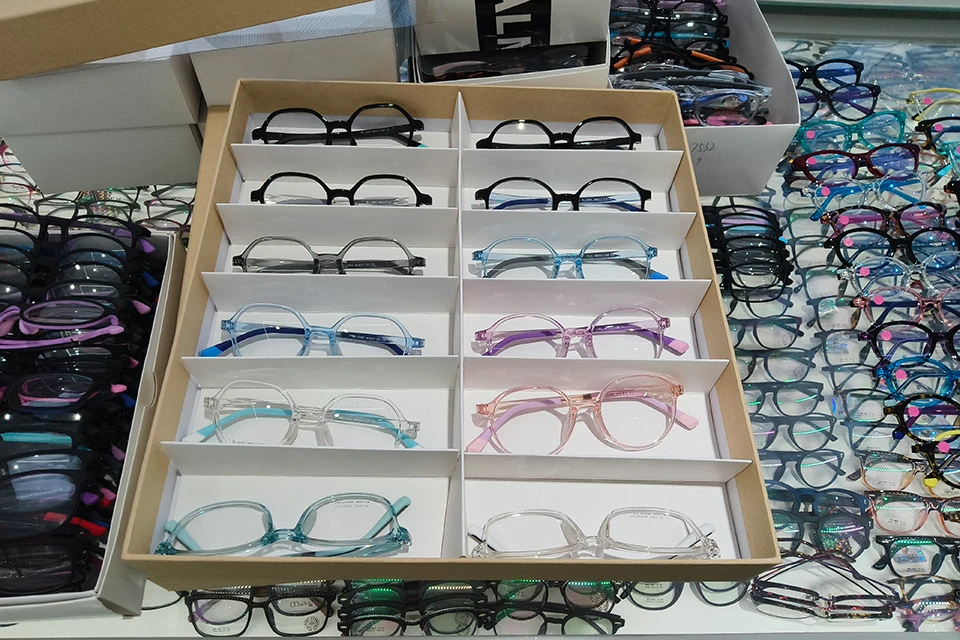
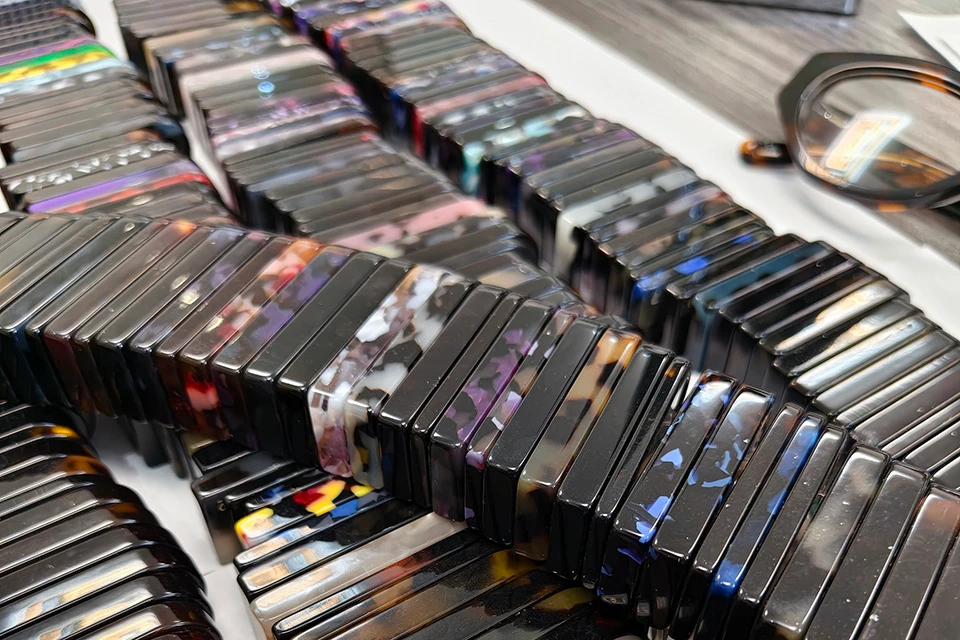
Color variety. Chinese acetate producers offer an extremely broad catalog of colors, patterns, and finishes. In terms of sheer variety, Chinese acetate often surpasses Mazzucchelli’s standard catalog. Custom color matching is readily available and affordable, making it easy to develop exclusive colorways for your brand.
Adequate durability. Modern Chinese acetate provides good structural integrity for everyday eyewear use. The material machines well on CNC equipment and accepts polishing to a satisfactory gloss. For mid-range and value-positioned products, the durability is entirely fit for purpose.
Batch variation. This is the primary trade-off. Color consistency between production batches can vary more noticeably than with Mazzucchelli. If you order the same tortoiseshell pattern six months apart, you may see visible differences in tone or pattern distribution. Experienced factories compensate by ordering larger material batches upfront or by carefully sorting sheets before production — but this adds complexity to inventory management.
Surface finish. Chinese acetate sheets typically require more tumbling and polishing time to achieve the same surface smoothness as Mazzucchelli. A skilled factory knows how to manage this, but less experienced producers may deliver frames with subtle surface imperfections that would not pass premium brand QC standards.
Cost and Sourcing
- Raw material cost: 30-50% lower than Mazzucchelli
- Impact on frame unit cost: Significant savings, especially at volume
- Minimum sheet order: Generally lower and more flexible than Italian producers
- Lead time for sheets: 4-5 weeks, with many colors available from stock
Best For
- Mid-range brands and value-oriented product lines
- Pharmacy, supermarket, and mass-market distribution channels
- High-volume production runs where cost efficiency is the priority
- Markets where “Italian acetate” is not a consumer purchasing driver
- Brands testing new styles or colors before committing to premium materials
- Private label and white-label programs where margin optimization matters
Japanese Acetate: Precision and Consistency
Industry Overview
Japan’s acetate sheet industry is smaller than Italy’s or China’s but is highly respected for its technical precision. Japanese manufacturers serve the domestic eyewear industry — particularly the renowned Sabae production cluster in Fukui Prefecture — as well as Korean and other Asian high-end markets. Major Japanese acetate producers include Daicel Corporation and several specialized sheet manufacturers.
Quality Characteristics
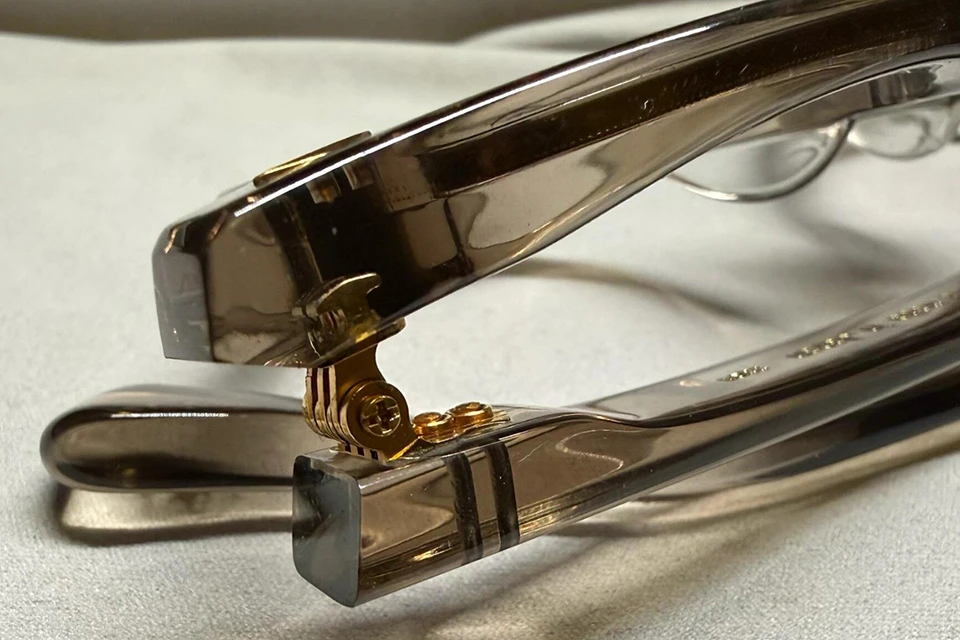
Dimensional uniformity. This is where Japanese acetate excels. Sheet thickness tolerances are extremely tight, typically within ±0.05mm across the entire sheet. This uniformity translates to frames with very consistent dimensions, which is particularly important for prescription optical frames where fit precision affects lens performance.
Elasticity and resilience. Japanese acetate sheets tend to have superior elasticity — they flex and return to shape more reliably under stress. This makes them excellent for frames designed to be lightweight yet durable, and for temple designs that need to maintain their curvature over years of daily use.
Temperature resistance. Japanese acetate performs exceptionally well under temperature variations. Frames are less likely to warp in hot climates or cold storage, which matters for brands distributing in regions with extreme temperature swings.
Color and finish. Japanese acetate is known for its density, purity, and structure. Each goes through extended curing and polishing cycles, giving them that deep glasses-like finish that collectors love, though the color range tends to be more conservative than Italian or Chinese producers. The focus is on technical performance and subtlety rather than bold fashion statements.
Cost and Sourcing
- Raw material cost: Comparable to or slightly above Mazzucchelli
- Impact on frame unit cost: Premium pricing, similar to Italian acetate
- Minimum sheet order: Varies by producer; can be higher for custom colors
- Lead time for sheets: 4-8 weeks
Best For
- High-end optical frames where dimensional precision is critical
- Japanese and Korean domestic markets where local materials carry prestige
- Brands emphasizing technical quality and engineering over fashion
- Prescription eyewear where lens-to-frame fit tolerances are tight
- Minimalist and understated design aesthetics
Side-by-Side Comparison Table
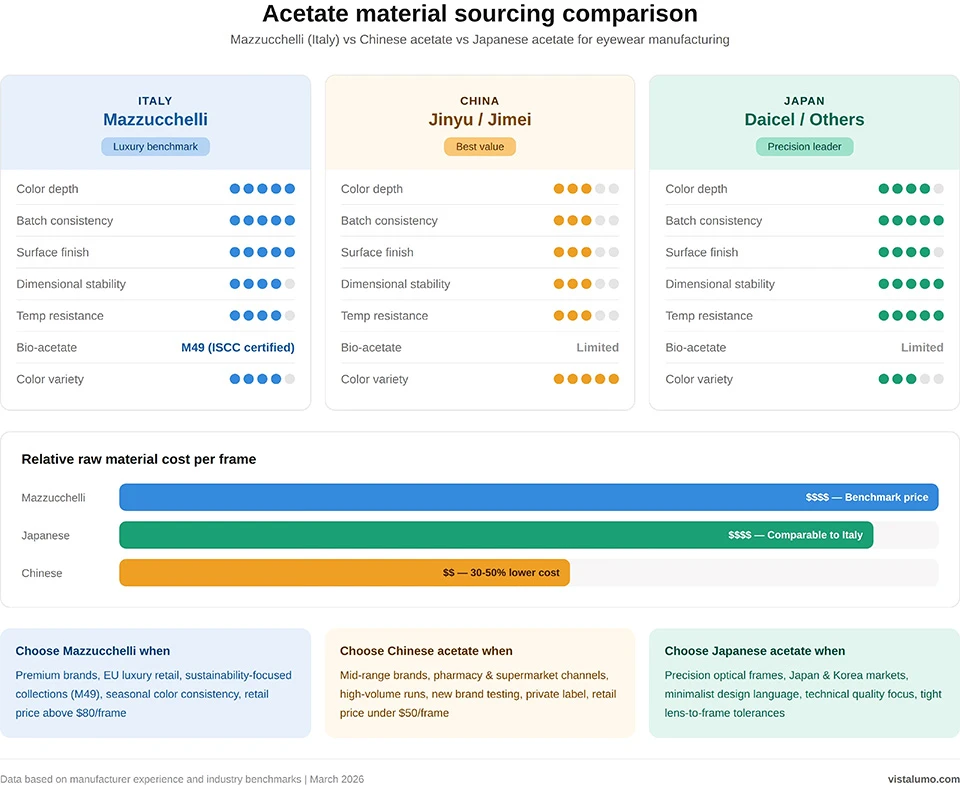
| Factor | Mazzucchelli (Italy) | Chinese Acetate | Japanese Acetate |
|---|---|---|---|
| Color depth & richness | Excellent — industry benchmark | Good — wide variety available | Very good — more conservative palette |
| Batch-to-batch consistency | Excellent — highly reliable | Moderate — can vary between batches | Excellent — very tight tolerances |
| Surface finish (pre-polish) | Very smooth — fewer polishing steps | Requires more polishing work | Smooth — moderate polishing needed |
| Dimensional stability | Excellent | Good | Excellent — best in class |
| Temperature resistance | Good | Good | Excellent |
| Bio-acetate option | Yes (M49, ISCC certified) | Limited availability | Limited availability |
| Color customization | Available at higher MOQ | Very flexible and affordable | Available but more conservative |
| Raw material cost | High (benchmark) | 30-50% lower | Comparable to Mazzucchelli |
| Best market fit | EU luxury, premium brands | Global mid-range, high volume | Japan, Korea, precision optical |
| Best brand positioning | Luxury, fashion-forward, sustainable | Value, accessible, mass-market | Technical, minimalist, precision |
| Typical frame price impact | +15-25% per unit | Baseline | +15-25% per unit |
How to Choose the Right Acetate for Your Brand
The decision is not simply “which is the best acetate” — it is “which acetate matches my business strategy.” Here is a practical framework:
Choose Mazzucchelli if:
- Your retail price is above $80 per frame
- You sell primarily in European or North American premium retail
- “Italian acetate” or “Made with Mazzucchelli” is part of your brand story
- Your brand need bold colourways
- Sustainability certification (M49 bio-acetate) supports your brand values
Choose Chinese acetate if:
- Your retail price is under $50 per frame
- You need maximum margin on high-volume orders
- Your distribution channels include pharmacies, supermarkets, or online value retailers
- You are launching a new brand and testing market response before investing in premium materials
- You need fast access to a wide variety of colors and patterns with short lead times
Choose Japanese acetate if:
- Your core product is precision optical frames
- You sell in Japanese, Korean, or other Asian markets where local material quality carries prestige
- Dimensional precision and long-term shape retention are your top priorities
- Your design language is delicate, minimalist, technical, or understated
Or use multiple grades strategically:
Many successful eyewear brands use different acetate grades across their product lines. For example: Mazzucchelli for the premium collection, Chinese acetate for the accessible line, and Japanese acetate for a technical collaboration. This approach maximizes margin across price tiers while maintaining quality appropriate to each segment.
At Vistalumo, we work with all three acetate origins and can help you select the right material for each product in your lineup. We maintain inventory from Mazzucchelli, Jinyu, Jimei, and other leading suppliers, so you can compare physical samples before committing to production.
Common Buyer Mistakes When Choosing Acetate
Mistake 1: Assuming all Chinese acetate is low quality. Chinese acetate has improved dramatically. For mid-range products, it delivers excellent value. The key is working with a factory that knows how to handle the material properly through its finishing processes.
Mistake 2: Paying for Mazzucchelli when the market does not demand it. If your frames retail at $25 in pharmacy spinners, Mazzucchelli acetate increases your cost without increasing your selling price. Match the material to the market.
Mistake 3: Ignoring batch consistency requirements. If you plan to reorder the same color repeatedly, discuss batch control with your factory upfront. This matters more with Chinese acetate than with Mazzucchelli or Japanese sheets.
Mistake 4: Not requesting physical sheet samples. Never choose acetate grade based on photos alone. Request actual sheet samples or frame samples in each material grade so you can compare color, weight, flexibility, and finish side by side.
What Vistalumo Offers
As a direct manufacturer with over 10 years of experience, we source acetate from multiple origins and can guide you to the right material choice for your specific project:
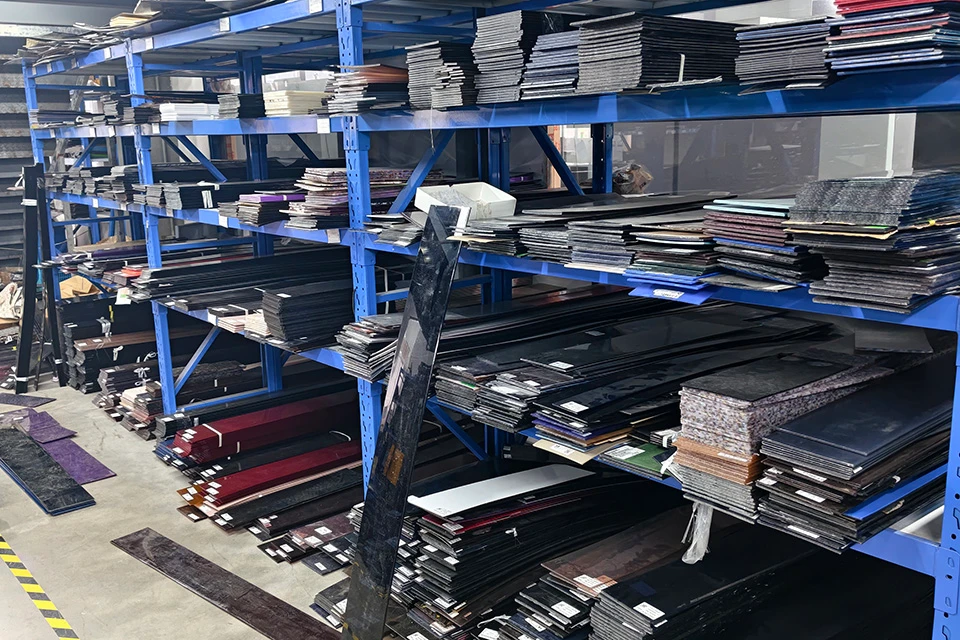
- Mazzucchelli (Italy): Available for premium and luxury collections, including M49 bio-acetate
- Jinyu and Jimei (China): Our standard supply for mid-range production, with excellent color variety
- Japanese acetate: Available on request for special market.
- Material sampling: We provide physical acetate sheet samples and finished frame samples in different grades so you can compare before ordering
→ Browse our acetate glasses collection to see frames produced with different acetate grades.
→ Explore our acetate sunglasses catalog for fashion and performance styles.
→ Ready to discuss your material requirements? Contact our team for a free consultation.
→ For the full picture on sourcing acetate eyewear — including OEM/ODM process, manufacturing, and compliance — read our comprehensive acetate manufacturer guide.
Related Articles
- Acetate Eyewear Manufacturer: The Complete OEM Sourcing & Material Guide
- TR90 Glasses vs Acetate: Which Eyewear Frame Material is Right for You?
- Custom Acetate Sunglasses from China: OEM Manufacturer Selection & Production Guide
- Bio-Acetate vs Standard Acetate: Why Sustainable Eyewear Materials Matter (coming soon)
- Acetate Glasses Color Trends 2026: What Wholesale Buyers Need to Stock (coming soon)
- Handmade Acetate Glasses vs Injection-Molded Frames: Quality, Cost and MOQ Compared (coming soon)
- CE and FDA Compliance for Acetate Eyewear: What Importers Must Know (coming soon)
- How to Start Your Own Acetate Eyewear Brand with a Chinese OEM Manufacturer (coming soon)
This guide is written and maintained by the Vistalumo Eyewear team — a direct acetate eyewear manufacturer based in Yiwu, Zhejiang, China, with 10+ years of experience serving global wholesale and brand clients. Last updated: March 2026.