How to Tell If Sunglasses Are Polarized: Complete Testing Guide for Eyewear Professionals
Polarized sunglasses are part of a specialty eyewear category that protects customers’ eyes from glare. So how do you know if they help? This article arms optical retailers, eyewear wholesalers, and sunglass brands with five dependable ways to verify that your shades are genuinely polarized, protecting your reputation and preventing customer returns. Stock high-quality polarized sunglasses you can be confident actually do deliver measurable eye protection benefits.
What Makes Sunglasses Polarized vs Regular Lenses?
Polarized lenses contain a special chemical film that deflects horizontal light waves. Regular sunglasses simply darken your view, leaving it at the mercy of the light filtering qualities of the tinted materials used. The key to the difference between the two lenses is in the light-filtering technology used to create the lens.
Because of their construction, polarized lenses prevent you from being dazzled by glare bouncing off reflective surfaces that may dark grey tints are unable to cut out.
According to The American Academy of Ophthalmology’s explanation of polarized lenses, This type of filter consists of aligned particles, or “molecules,” that preferentially absorb horizontally polarized light (which is often created by reflection off of flat surfaces like water, snow, or car hoods) while allowing only vertically polarized light waves to pass through.
Sunglasses manufacturers must be aware of this distinction; when their customers request glasses that eliminate glare they mean serious business. When on demand regular sunglasses, the lens technology is what truly matters in the performance differences that people find literally hard to see. Stores that sell sunglasses and sport eyewear will need to verify that their stock qualifies as polarized.
Why Verifying Polarized Lenses Is Critical for Eyewear Businesses
Customer satisfaction is based on the promise of prescriptive polarization benefits (sunglasses that aren’t polarized can fail in driving or water activities.) More product comes back at you if the polarization isn’t high quality or if those didn’t get labeled as polarized in the first place! Optical retailers protect their reputations, and therefore test every shipping getting delivered to their product tables long before they take receipt of it themselves.
Wholesale suppliers of eyewear sometimes don’t label, mistakenly or otherwise, lenses as polarized. Inexpensive manufacturers advertise polarization, yet don’t deliver the layers of film needed to truly produce them. Distributors of eyewear caught peddling fake polarized glasses can be held liable.
As a professional eyewear manufacturer, Vistalumo maintains rigorous brand standards for material quality control in collaboration with our lens suppliers. Only by providing high-quality polarized sunglasses can we retain customers, build lasting trust, and foster long-term partnerships.
How Does the LCD Screen Test Identify Polarized Sunglasses?
LCD screen method
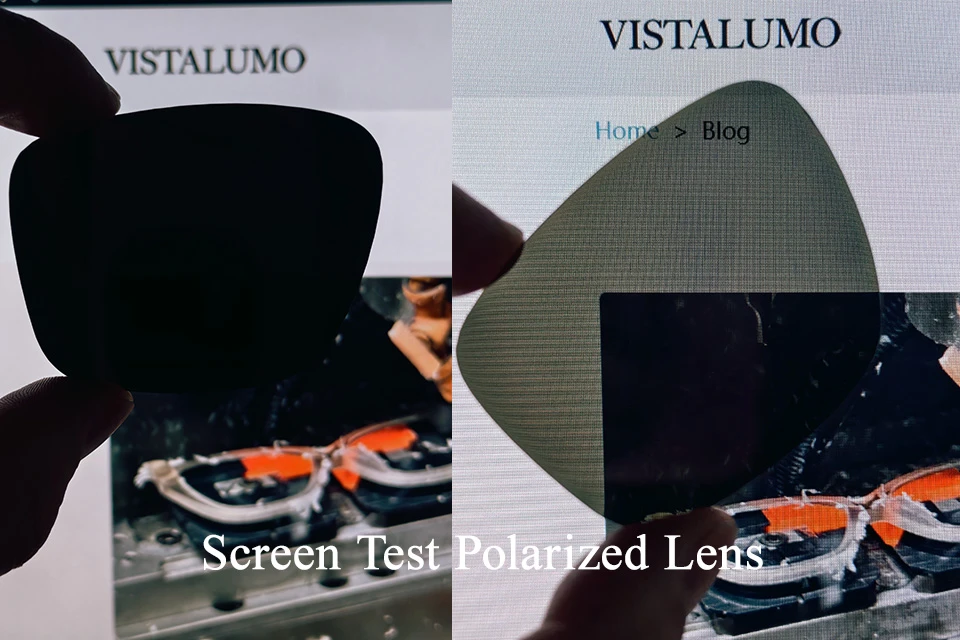
A super-fast way to check whether lenses feature light filtering properties is the “LCD screen” approach. Simply hold your sunglasses in front of a digital display at the same angle you’d normally view the screen and look through the lenses. By slowly rotating the frames 90 degrees, true lenses will cause the screen to pretty much blackout.
True lenses: During its manufacture, the LCD screen we’re seeing through was aligned to emit light in a particular direction. When the lens filter is then rotated perpendicular to that light, most of the reflections are thus blocked and the display therefore darkens immensely. Ordinary tinted lenses don’t darken upon rotation, doing little or nothing to the quality of display.
In stores, the retail team often demonstrates lens efficacy this way to customers. Mobile phones, tablets or computer monitors all work for quick checks. The degree of darkening—the darker, the better—can also suggest the overall effectiveness of the lens, with lower-grade lenses dimming only partially.
The entire cycle takes fewer than 15 seconds and special gear is not required.
Can Water Reflection Be Used to Check Polarized Sunglasses?
A nice free method for identifying the presence of this important glare-reducing filter in lenses, is to hold sunglasses between your eyes and a surface of water: pool, lake, or calm shore area. Observe the surface reflected glare through the lenses, then move the frames slowly in a tilt/turn fashion as you observe what this does to the surface reflections.
Lenses constructed to control light being reflected from surfaces will reduce the reflected glare off the water when viewed at a certain angle. Often, the surface reflection will simply disappear and it will be easier to see into the water below. A normal tinted lens will make no difference whatsoever as the angle of view changes.
This is an easy and effective method for eyewear brands and manufacturers who use product demonstrations and lifestyle photography. Side by sides will show customers the immediate determining difference ultimately justifying paying for glare-reduction in real life setting situations. Why these are better boating, fishing, and beach lenses.
The Two-Lens Cross Test for Verifying Polarized Lenses
Another of the reliable tests for determining if your sunglasses use real polarization is the two-lens cross test. In this technique, keep two pairs of sunglasses that are both said to employ glare-reducing lenses.
Place one lens directly on top of the other so that the two lenses completely overlap. Now take a look through the overlapped area while slowly turning one of the pairs. Once again, as in the last test, turning should occur in such a way that you arrive at a 90-degree “cross” position of the two lenses. This time, the overlapped area should appear dark, or for sunglasses a manufacturer can swear by, nearly black. If both contain a proper polarizing layer, this cross darkening should occur. The reason it “disappears” into darkness is that each lens acts only on light traveling in a specific latitude. If the axes of filtering are “peaked” together in the 90-degree position, most of the light traveling in will be blocked. If the lenses remain transparent, or even passable in an obvious dimming of the light coming through them, one pair at least does not have real polarization in it.
The two lens test is frequently used by many people, including custom eyewear manufacturers, Quality Control Inspector persons, even wholesale purchasers, because there’s no special tool needed, and the test yields immediate results, particularly for a visual inspection of an entire lot. This same test comes in quite handy when checking the received inventory of sunglasses going out for displacement into stores.
What Are the Benefits of Polarized Sunglasses Compared to Standard Options?
Sunglasses that combat reflected light are more than just sun protection: in bright conditions, they increase visual contrast and colourisation is accurate. The depth of vision is improved, and judging distance is easier – an essential requirement for anyone who spends time outdoors.
Different shapes of lenses can be obtained. For walks in areas with minimalising concentration on increasingly brighter scenery where glare is slight, generally tinted lenses are suitable. In areas of high reflection – ice, water, snow, bright roads, etc., specialist lenses come into their own and they are especially beneficial for drivers, fishermen, skiers, and cyclists. In other sports where stainless eyes and a maximum of comfort are essential, glasses that serve to lessen reflected light are highly desirable.
Long exposure of the eyes to bright light may produce fatigue and possibly even the start of a adache later in the day, all due to glare. Lenses that cut down reflections serve to relieve this strain and increase comfort in wear. When the plus factor is added to the lens for correction of refractive error, the combination of bright and comfortable vision is achieved. That is the appeal of genuine glare-reducing sunglasses, of which the retailer should be proud to assist the wearer in gaining the many benefits they confer.
When Should Customers Choose Glare-Reducing Sunglasses Over Standard Eyewear?
Sunglasses that reduce reflected light are likely to appeal to a smaller group of people. Situations such as driving on wet roads, dealing with glare from oncoming headlights, and spending time near water all require clearer vision and less eye strain. Sunglasses for driving can be designed in many different ways. Outdoor activities like sailing, fishing, and cycling, as well as skiing on snowy slopes during the day, can be very bright and may be too much for regular tinted lenses to handle.
There are some special cases where these types of lenses may not be the best choice. Some pilots prefer not to use them because they can make it difficult to read important information in the cockpit. Experienced skiers on rocky, icy slopes often want to see as much of the surface as possible, including textures and obstacles like boulders, rather than reducing glare.
For most people, however, sunglasses that reduce glare will likely remain the top choice for everyday wear. Tinted glasses are suitable for short trips, shady areas, and situations with less reflection. When it comes to choosing the right kind of daily glare protection, an eyewear professional can help make a sensible decision. Basically, matching the lens to the person’s lifestyle ensures they get the right product with no unnecessary features.
Do Glare-Reducing Lenses Block UV Rays the Same Way as Standard Tints?
Glare control and UV protection are separate functions of lenses. They often go together, but don’t necessarily depend on each other. Glare control refers to the reflected light that is uncomfortably bright. UV protection refers to ultraviolet rays, which have harmful effects on eyes. Where glare protection works on the concept of filtering light that impinges on the eyes in a direction substantially at right-angles to the plane of the lenses, UV protection is obtained from a light-filtering material itself or from a coating that is already present or deposited on the lens surface. The presence of one hardly means that the other must also be present.
Exposure of eyes to ultraviolet radiation occurs quite as differently as exposure to glare does.
Lenses that are primarily designed for glare reduction, unless treated with materials or films that further absorb ultraviolet rays, will probably afford no appreciable protection.
How to Source Sunglasses with Verified Glare-Reduction Performance for Wholesaler
Glare-control claims need proof before you buy. Always ask for samples to test. If you check these samples before shipping, it helps avoid selling poor-quality “samples.
Reliable suppliers provide specifications and support independent testing. Inexperienced “value” suppliers often hide safety issues. They may refuse to let an optician see their control samples or lack proper lab tests.
Success in sunglasses sales comes from suppliers who consistently meet quality standards. Regular sample testing can reveal issues, even if you trust the supplier. Ultimately, the consumer benefits, and since shoppers see retailers as “experts” in sunglasses, their expectations will be met.