Most inquiries we receive open with the same two questions: what is your MOQ, and can you make this design. Both are fair. But they skip the question that decides everything downstream: what kind of program are you actually running, and what does the road from first email to final delivery look like in practice.
This guide maps that road the way we run it at our factory in Yiwu, China: eight stages from inquiry to after-sales, the timelines we actually commit to, where the costs sit, and the points where first orders most often go wrong. It is the same process behind our eyewear OEM ODM services, and it applies whether you are a pharmacy chain, a distributor, or a brand launching a first collection.
One note on how to use it. If you are weeks from your first order, read it start to finish. If you are mid-program and something feels off, jump to the stage you are in; each section stands alone, and each names the questions worth asking your supplier at that point, including us.
OEM vs ODM: know which path you are on
The two terms get used loosely, so here is the working distinction.
OEM, original equipment manufacturing. You bring the design: a tech pack, drawings, or a sample to replicate. The factory manufactures to your specification. You own the design; the factory contributes process and capacity.
ODM, original design manufacturing. You start from the factory’s existing models and customize them: your acetate colors, your temple logo, your lens spec, your packaging. The base design is the factory’s; the branded result is yours.
Most real programs are a blend. An existing frame silhouette in your custom color, with your logo and your packaging, is ODM with OEM elements, and it is how most brands sensibly start.
The path you are on decides four things: whether molds are needed, what the minimums look like, how long sampling takes, and who owns what at the end. What tooling means depends on the material. A genuinely new injection design in PC or TR90 needs a private mold: a real tooling fee, and commonly around 15 to 20 days of mold making before anything else can move. Acetate works differently: frames are CNC cut from sheet, so there is no mold and no tooling fee, though special requests such as a custom metal logo or a custom wire core can add cost. ODM from existing models means samples in days and no tooling bill either way.
If you are unsure which path fits, the decision usually makes itself once you answer two questions. Is your design genuinely new, or is it a recognizable shape with your identity applied? And can your first order absorb tooling and a longer schedule? New design plus tooling budget points to OEM. Everything else points to starting ODM and graduating to private tooling once sell-through proves the model. There is no prestige penalty in starting ODM; there is a real cash penalty in tooling a design the market has not voted on.
Two points are worth settling early. First, ownership: if you invest in a private mold, the contract should state plainly that the mold and the design are yours. Second, inspiration: if your brief is “like a famous model but slightly different”, pause and talk trademark safety before anyone cuts steel. A good factory will raise this even if you do not.
Before stage one: vet the factory, not the salesperson
Everything below assumes you are dealing with a real factory rather than a trading desk with a factory photo. The fastest filters: a live video walk-through, audit reports with numbers you can verify, test documents named for your specific market, and batch QC records shown rather than promised. The 8-point vetting checklist in our wholesale reading glasses guide was written for readers programs, but it applies to any eyewear category unchanged.
Stage 1: Inquiry and specification (2 to 5 days)
A complete brief gets a real answer in days. An incomplete one starts a week of back-and-forth. The brief that moves fastest covers six things:
- Channel and market. Pharmacy, optical retail, e-commerce, distribution, promotional. The channel decides material tier, packaging format and the certificates you need, so a supplier who asks about it before quoting is reading your program, not just your quantity.
- Quantities. Pieces per style and color, plus how many styles you plan to run.
- Target. Either a unit price band or a landed budget. Both work; silence on price wastes a full round of quoting.
- Product spec. Materials, sizes, lens requirements, and powers if you are buying readers.
- Packaging. Case, pouch, cloth, box, display format: decided now, not after production starts.
- Timing. Any target window you are working toward, so we can plan production and transit around it.
Two to five days is a realistic window for specification alignment when the brief is complete. On the factory side, those days are not idle: we check material availability against your colors, flag any compliance requirement your market adds, and confirm whether your spec fits existing models or needs development. If a supplier returns a price in an hour without a single question, the quote is generic and so is the attention your order will get.
This stage costs nothing, and it is also diagnostic: how a factory handles your questions now is how it will handle your order later.
Stage 2: Quotation: read the structure, not just the number
Ask for tiered pricing rather than a single figure. A typical structure runs your MOQ, then roughly 2x, 5x and 10x volumes as tiers, with unit price improving at each level, and serious quotes carry a validity window, commonly around 30 days, because acetate sheet and lens prices move.
A quote worth signing itemizes what the unit price contains: frame, lens spec and coatings, logo application, case and packaging, and which freight terms the numbers assume. A single blended number with no breakdown is where surprises hide.
Watch for two quiet traps. The first is a headline price that only applies at a tier far above your real quantity; always confirm the price at the quantity you will actually order. The second is a lens or coating specification that drifts downward between quote and sample. The fix for both is the same: get the full specification written into the quote, and check the sample against that document rather than against memory.
Then compare landed cost, not unit price. Freight, duties and compliance testing land differently by market and by terms. US buyers in particular should model tariffs into the comparison before choosing between suppliers or between terms.
Payment norms in this category are stable: a 30% deposit with the balance before shipment is standard, and platform trade assurance is a reasonable comfort on a first order. Specific terms belong on the quotation itself, not in a blog post, so treat anything you read here as the range and your signed quote as the contract.
Stage 3: Sampling (7 to 10 working days for existing models)
For existing models, 7 to 10 working days is a realistic sampling window. Fully custom designs take longer, and anything involving new tooling adds the mold time on top. Sample fees are commonly deductible from the first order; ours are for existing models. Sample types, what drives the fee, and the eight-point brief that gets the first sample right are covered in our detailed sampling guide.
Treat the sample as two products in one. The first is the physical frame: check spec accuracy against your brief, hinge feel, surface finish, logo position and lens quality, in daylight and not only under office lighting. The second product is the factory itself: sampling speed, how precisely your spec was read, and how change requests are handled are the best predictors of how your production order will run.
When you approve a sample, record the approval properly. The approved piece becomes the reference standard for production, so photograph it, note the spec it embodies, and keep one sealed reference if quantities justify it. Verbal approval of a sample nobody kept is how “this is not what we approved” disputes are born, and they are entirely preventable.
If you sell online and run virtual try-on, this is also the stage to ask about 3D files for your SKUs, because building them alongside physical samples is cheaper than retrofitting them later.
Stage 4: Molds and tooling: when they apply and when they do not
Tooling is the most misunderstood cost in eyewear, so here is the working map.
- Injection frames in PC or TR90: molds required. A new injection shape needs a private mold: a real tooling fee, and commonly around 15 to 20 days to cut the mold before the first order can run. Open molds, meaning existing shapes any customer can order, carry no tooling fee.
- Acetate frames: no mold fee, but watch the extras. Acetate is CNC cut from sheet, so there is no mold and no tooling fee. Special requirements are the exception that can add cost: a custom metal logo, a custom wire core, or similar bespoke components are quoted on top.
- Custom metal parts: tooled per component. Special hinges, decorative temple pieces and custom metal fronts are tooled piece by piece.
Where private tooling applies, amortizing the fee across early orders is a common arrangement; the exact split belongs on the quotation. The planning rule is simple: if your first order cannot carry a tooling line item, start from open molds or sheet acetate, and reserve private tooling for the reorder that proves the model.
Stage 5: Production: what 40 to 45 days actually contains
Production starts after sample approval and deposit, and 40 to 45 days is the realistic planning number for customized programs. Inside that window: material procurement, cutting or injection, tumbling and multi-stage hand polishing for sheet acetate work like our acetate optical frames, hinge setting, assembly, lens cutting and fitting, logo application, cleaning and packing.
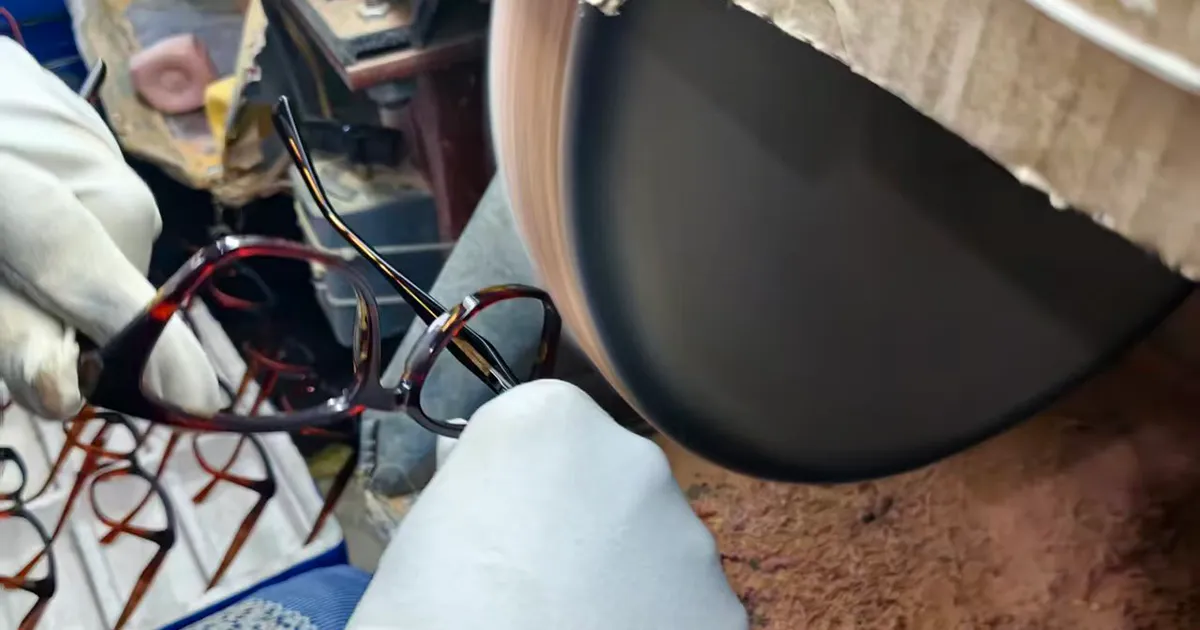
Depth of customization is what moves the clock. Logo work on frames plus matched cases and cloths, special packaging print runs, and mixed power assortments for reading glasses programs all add real steps. None of them are problems; all of them belong in the schedule from day one, not discovered in week three.
During production, agree the communication rhythm up front: what updates you get, at which milestones, and with photos of what. A weekly status with images at material, assembly and packing stages is a reasonable ask and costs a factory nothing if the order is actually on schedule. Also agree the change cutoff. Small adjustments are often possible before cutting and printing start; after that point, changes cost real money and real days, and a factory that says yes to everything mid-production is quietly deciding which corner to cut.
Two calendar notes catch first-time importers. Chinese New Year closes factories for weeks, and the ramp-up after reopening is slower than most buyers expect; as a working rule, orders confirmed after mid-November ship after the holiday. And for distributors weighing local lens labs against one-stop supply, frames shipped edged and assembled are an option worth pricing at this stage rather than after the frames land.
Stage 6: Quality control: agreed in writing, checked in batches
QC that protects you has two layers. Inline checks during production catch drift early, while a final random inspection against an AQL agreed in writing settles acceptance; AQL 2.5 for major defects and 4.0 for minor is a common baseline in this category. For readers, diopter verification on a focimeter with batch records is the single check that most decides your return rate. Color is confirmed under a standard light source, because warehouse lighting hides shifts that shop lighting reveals.
Two questions filter suppliers faster than any brochure: what tolerance do you actually work to, and can you show recent batch records rather than a one-time certificate. Third-party inspection from SGS, QIMA and similar firms should be welcomed by your supplier, not negotiated. So should document requests: batch QC records and test reports named for your market are reasonable asks, and we provide our documentation for review on request.
Agree in advance what happens when an inspection fails: sorting or rework at whose cost, re-inspection terms, and the schedule impact. Failure handling negotiated before production is a clause; negotiated after a failed report, it is a standoff with your launch date as the hostage.
Stage 7: Packaging and retail readiness
Packaging is part of the product in this category, and it is cheapest when planned with the frames rather than after them. Because we make custom eyeglass cases, pouches and cloths in-house, frames and packaging leave in one shipment with consistent branding and one consolidation step removed.
What to settle before production starts: case and pouch selection, logo methods across frame and case, barcode application, inner and master carton labeling to your warehouse specification, and any display or blister format for pharmacy programs.
For readers programs specifically, settle the power labeling scheme before production: where the sticker sits, how large the figure reads, and whether colors code the powers. It is a small decision at the packing line and an expensive retrofit on boxed stock.
If you sell on marketplaces, prep requirements are their own specification, from poly bags to label placement, and they are far cheaper to meet at the packing line than at a prep center.
Stage 8: Shipping, documents and after-sales
Terms first: EXW, FOB, CIF and DDP shift cost and risk between you and the factory in different ways, and the right choice depends on order size and your import experience. Sea freight commonly runs 25 to 40 days to Europe or North America; courier and air freight suit small launches and top-up stock.
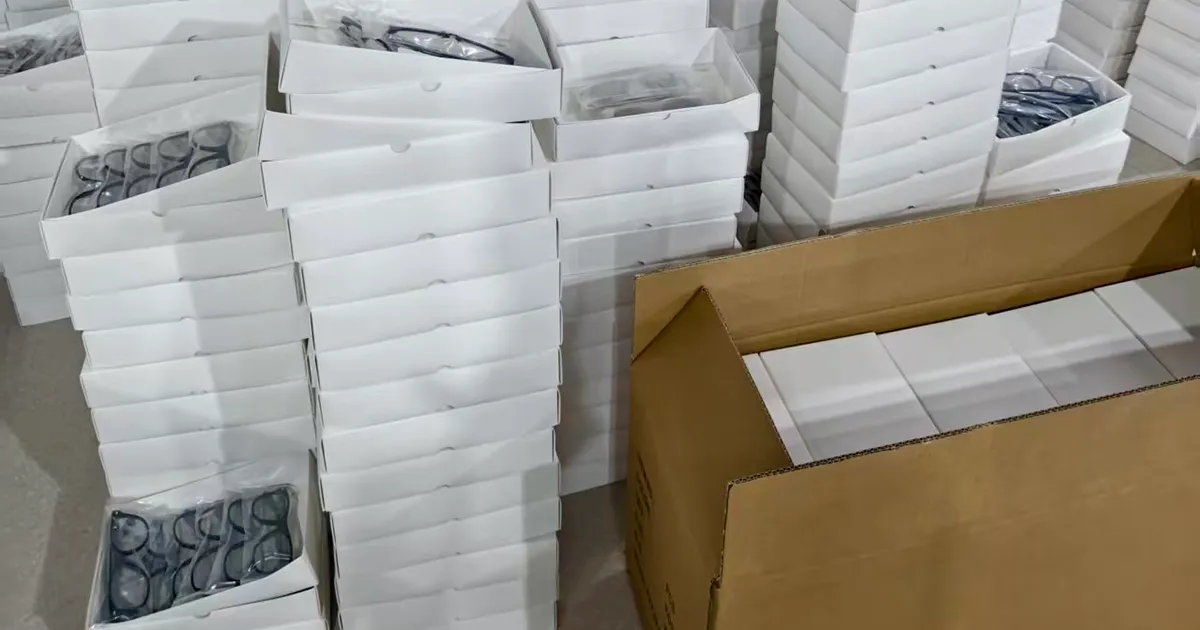
The document set travels with the goods: commercial invoice, packing list, and the certificates and test reports your market requires. Ask for them before shipment, not at customs, and confirm in writing which items your supplier can produce.
After-sales belongs in writing before the deposit, not after the claim: defect coverage, spare parts availability, and the claims workflow when something does go wrong. For frames, spare temples, screws and nose pads shipped with the order are cheap insurance against returns for trivial faults; agree whether and how your supplier supports this. A supplier confident in their own QC will put these terms on paper without being pushed.
What a compressed order looks like: 35 days, Germany
The stages above are the standard road. Under pressure, the road can compress, and it is worth seeing what that actually costs. We delivered a custom sunglasses order for a German fashion brand in 35 days from brief to delivery, documented step by step in our case study of the 35-day German order. The compression was real, but so were its conditions: a complete brief on day one, decisions returned in hours rather than days, a rush mold, and a hand-carry finale to hit an immovable date.
The honest reading of that project is not that 35 days is the new normal. It is that elasticity exists when both sides buy it with speed and completeness. For planning, keep 40 to 45 days of production in the calendar and treat anything faster as an exception you negotiate, not an assumption you build on.
When custom OEM is the wrong answer
Custom manufacturing is a volume game, and it is fair to say plainly when it does not fit. If your total need is under roughly 1,200 pieces per style, or you need sellable stock in less than about six weeks, a stock purchase from a wholesaler will serve you better than any custom program, including ours. The middle path is logo work on existing models: low cost, a faster road, and a real brand presence while you test demand. Our private label eyewear guide maps that route, budgets included.
We do our best to walk you through every detail of the process at the inquiry stage, so your program is set up to perform in the market. That early conversation takes time, but it is necessary time: we believe anything worth doing deserves to be done professionally.
FAQ
What is the difference between OEM and ODM for eyewear? OEM means you bring the design and the factory manufactures to your specification. ODM means you customize the factory’s existing models with your colors, logo, lenses and packaging. Most programs blend the two, and starting from existing models is the faster, lower-tooling route for a first collection.
What is the typical MOQ for custom eyewear? Industry norms typically run 400 to 500 pieces per style and color. We work from 1,200 pieces per style with a minimum of 400 pieces per colorway, so one, two or three colorways all clear at the same 1,200 and wider color ranges scale with the color count.
How long does the whole process take? For existing models: 2 to 5 days of specification, 7 to 10 working days for samples, then 40 to 45 days of production after approval, plus transit by your chosen method. New tooling extends the schedule. Our fastest documented project ran 35 days from brief to delivery, and it was a compressed rush order, not the planning standard.
Do I have to pay for molds? Not for acetate frames, which are CNC cut from sheet without tooling; only special components such as a custom metal logo or a custom wire core are quoted on top. New injection designs in PC or TR90 need a private mold, with a tooling fee and commonly around 15 to 20 days of mold making, while open molds carry no tooling fee. Custom metal parts are tooled per component. Where tooling applies, fee amortization across early orders is a common arrangement, with exact terms on the quotation.
What payment terms are standard? The industry standard is a 30% deposit with the balance paid before shipment.
What files do you need for an OEM quote? For OEM work: technical drawings or a tech pack with dimensions, materials and finish, or a physical sample to measure. For ODM work: reference photos of the direction you want, your logo files in vector format, and your packaging requirements. The more complete the input, the more accurate the first quote, and the fewer rounds you spend converging.
Can frames and packaging ship together? Yes. Cases, pouches, cloths and retail packaging are made in-house and leave in the same shipment as the frames, which keeps branding consistent and removes a consolidation step.
Ready to map your program?
Tell us a bit about your program: what you sell, roughly how many pieces, your market, and any timing you are working toward. Send it through our quote form and we reply within one working day with a practical plan, not just a price list.